

Shoulder Pain & Rotator Cuff Issues
While acute shoulder injuries such as dislocations, separations, or major tears do occasionally present to the clinic and are often referred out when appropriate, the majority of shoulder problems seen at Integrity Chiropractic tend to develop gradually over time. These are the types of shoulder issues that build slowly, sometimes over months or even years, before becoming limiting or painful enough to seek care.
In many cases, people cannot point to a single moment when the problem started. Instead, it often begins as a mild discomfort with certain movements, a subtle loss of shoulder mobility, or a feeling that the shoulder is not moving quite the way it used to. Over time, as these small changes accumulate, the shoulder becomes less tolerant to everyday demands such as lifting, reaching, or training.

Common Shoulder Conditions Seen in the Clinic
Most non-traumatic shoulder complaints tend to fall into one of these areas:
-
Rotator cuff and biceps long head tendinopathies
-
Impingement-related pain
-
Chronic post-surgical shoulder pain
-
Lingering stiffness after frozen shoulder
-
Acromioclavicular joint and ligament degeneration
These conditions affect a wide range of individuals. Some are highly active in the gym or participate in sports regularly, while others work physically demanding jobs or spend long hours at a desk. There is rarely a “typical” shoulder patient.
It is also common for more than one area to be involved. The shoulder is a highly mobile and complex joint, and dysfunction in one structure can often influence others, leading to overlapping symptoms and patterns of discomfort.
Common Shoulder Pain Presentations
Shoulder issues often creep up gradually rather than announcing themselves with a single injury. Here are a few patterns we see most often:
-
Overhead reaching or lifting: pain or weakness when you put something on a high shelf or take a dish out of a cupboard.
-
Behind‑the‑back movements: discomfort fastening a seatbelt, hooking a bra strap or reaching behind to grab something from the back seat.
-
Pressing or pushing: sharp twinges during push‑ups, bench press or simple tasks like pushing a door open.
-
Sleeping on one side: waking up with a throbbing ache after lying on the affected shoulder through the night.
-
Carrying loads: soreness when holding a child, carrying groceries or lifting suitcases, especially if the arm stays out to the side.
Shoulder problems don’t often resolve on their own because multiple structures tend to be involved. If any of these patterns ring true, an early assessment can uncover which tissues are irritated and address other factors contributing to and associated with the pain.

What's Often Missing with Shoulder Training
Even in individuals who exercise consistently, shoulder training is often incomplete, particularly in those who have not spent time training under experienced guidance or with a structured approach to improving movement.
Programs may emphasize strength or larger muscle groups but lack balance in areas such as:
-
Stability
-
Motor control
-
Coordinated movement across the shoulder complex
As a result, the shoulder often receives less focused attention than it requires to function well over the long term. Over time, these gaps can contribute to gradual changes in movement and load tolerance, affecting the tendons and joints and making the shoulder more sensitive to stress.
Why Shoulder Pain Becomes Persistent
Although the shoulder conditions mentioned previously are distinct, they often present with or progress into similar and persistent patterns of pain and dysfunction.
In practice, it is common to observe:
-
Protective guarding in the muscles around the armpit
-
Overactivity or dominance of the upper shoulder blade muscles
-
Reduced strength and control of the muscles that stabilize the shoulder blade
While the primary sources of pain can often be identified and treated, the shoulder frequently needs to be addressed as a whole system rather than a single structure to achieve lasting improvement.
Emerging research continues to support this broader view, suggesting that shoulder pain is often influenced by multiple interacting factors rather than a single isolated issue, much like the low back.
Without this approach, symptoms can persist or recur even after initial relief.

Deep Dive: A Common Pattern
One of the most common limitations seen in the clinic is difficulty raising the arm overhead.
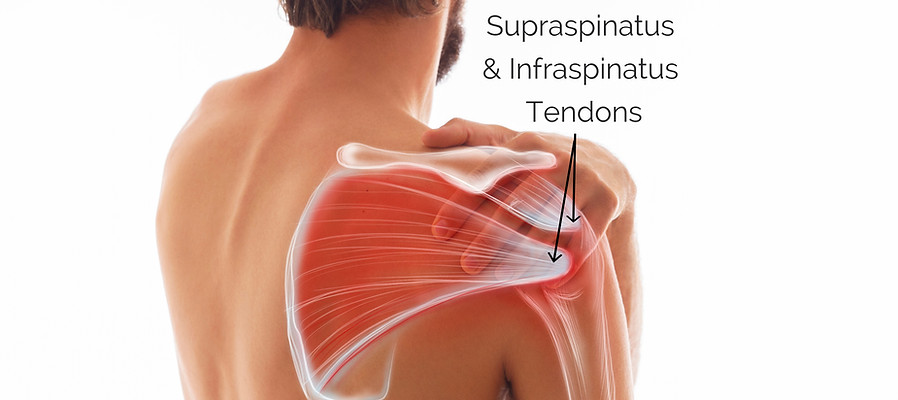
In many of these cases, the rotator cuff tendons, particularly the supraspinatus and infraspinatus, become irritated as they pass beneath the acromion, often referred to as the “roof” of the shoulder.
This is commonly diagnosed as “impingement” or bursitis. These terms describe the compression occurring in this space but do not fully capture the underlying condition of the tendons. In many cases, the tendons have already been affected by chronic stress and suboptimal mechanics, making them more sensitive to compression and load. Palpation and comparison to the unaffected side often reveal a clear difference in tissue sensitivity. These observations are also supported by current research, which suggests that the term “impingement” may not fully capture the complexity of shoulder pain.
When these tendons are addressed, patients frequently experience:
-
Reduced pain
-
Improved overhead motion
Sometimes within a relatively short period of time, even before changes to movement patterns are addressed.
Why Pain Improves, But Doesn’t Fully Settle
Even after initial improvement, many people continue to notice lingering discomfort in the front of the shoulder.
This is partly because the movement patterns and mechanics that contributed to the issue are often still present. In many cases, additional structures may also be involved that have not yet been directly addressed. The long head of the biceps tendon is commonly one of these contributors in conjunction with rotator cuff irritation.
Some researchers consider this tendon to be functionally part of the rotator cuff system due to its role in stabilizing the shoulder. As the rotator cuff becomes irritated, its ability to control the position of the joint can be reduced. The biceps tendon may then take on more load to assist with stability, which can lead to irritation along the groove at the front of the shoulder.

A Simple Observation
While raising the arm overhead is often clearly limited, another movement we frequently assess is reaching the hand behind the back toward the opposite shoulder and comparing it to the unaffected side.
Although this is commonly used as a general movement screen and can reflect tightness in several structures, clinical experience has shown a consistent relationship between this limitation and increased tension in the long head of the biceps tendon.
This supports the idea that the biceps is acting as a stabilizer. When the arm moves behind the back, limited ability to lengthen through the muscle and tendon can restrict motion and place strain on the front of the shoulder, which may become uncomfortable or painful.
As a result, this often becomes an important area to address as part of a more complete approach.
Why A Broader Approach Is Needed
Addressing one structure in isolation may provide short-term relief, but it often does not resolve the full picture.
Long-term improvement typically requires:
-
Restoring mobility
-
Improving coordination
-
Reducing unnecessary strain across the system
-
Integrating the core with shoulder movement for better load management and force transfer
-
Managing symptoms effectively during the recovery process
This is one reason why some people find that exercise alone can help partially but does not fully resolve their symptoms. While many rehabilitation programs address these areas, progress can sometimes be limited by factors such as time constraints, incomplete carryover outside of sessions, or challenges with managing symptoms along the way.
These factors often require a more individualized and thorough approach to fully address the issue.
What Leads to Shoulder Breakdown
Common contributing factors include:
-
Repetitive overhead work (drywalling, window washing, carpentry)
-
High-volume overhead sports (tennis, volleyball, badminton, pickleball, swimming)
-
Poor load management or continuing to train through pain
-
Consistently sleeping on one side
-
Poor metabolic health
These factors are supported in both research and clinical practice and can gradually increase stress on the shoulder over time, often without noticeable symptoms until the tissue becomes more sensitive or movement becomes limited.

Why Treatment Sooner Is Better Than Later
Shoulder issues tend to respond more favorably when addressed early.
In earlier stages:
-
Tissue irritation is usually milder
-
Movement patterns are less altered
-
Recovery is often quicker
In some cases, only a few visits and simple changes are needed to help things move in the right direction. When symptoms have been present for months or longer, recovery often takes more time as the body has adapted to the problem.
Addressing the issue earlier can often simplify the process and lead to more consistent long-term results.