

Tips For Desk Work and Your Body
Quick and practical strategies for reducing neck, shoulder, and low back strain while working at a desk by Dr. Wen

Desk jobs are a reality for many of us, and over the last several years people have become even more deskbound. Patients who spend long hours at a computer also make up the largest group of people I see at Integrity Chiropractic. Having worked desk jobs myself before entering healthcare, I know firsthand how much it can affect your body.
Patients often ask what they can do on their own to manage aches and pains. While treatment can be very effective for reducing pain and restoring movement, my philosophy has always been that patients should also take an active role in taking care of their body. In many ways, movement and self-care are no different than maintaining a healthy diet — small consistent habits matter.
This guide isn’t meant to diagnose every issue related to neck or back pain, but it covers many of the common patterns I regularly see in desk workers. If something is significantly bothering you, don’t spend months trying to self-diagnose online. Seek help. From me, or another qualified practitioner.
Neck, Shoulder, and Upper Back Pain
Office workers commonly come into my office saying things like:
-
“Something is pinching in my shoulder blade.”
-
“My shoulders and upper back always feel tight.”
I’ve had days like this myself during my years working in tech, and it’s not fun.
The muscles in your neck and upper shoulders are already working hard throughout the day simply supporting the weight of your head, which weighs roughly as much as a bowling ball. Add hours of typing, reading, leaning forward, and shrugging the shoulders toward a keyboard and those muscles often become chronically overworked. Many people also spend the day hunched forward over a screen. Over time this can tighten the muscles that help keep you upright, round the upper back and shoulders, and gradually distort posture in a way that becomes harder to undo later.
Make Your Workstation Work for You
You have to survive an eight-hour (more like twelve) workday, so your strategy should focus on reducing the amount of unnecessary stress your body experiences throughout the day.
Raise Your Monitor Higher
One of the simplest and most effective changes I recommend is raising your monitor higher than traditional ergonomic advice often suggests.
A lot of ergonomic recommendations place the top of the monitor around eye level, but many people still spend the majority of the day looking slightly downward. While subtle, this often increases the amount of work your upper traps and levator scapulae need to do to support your head over time.
Modern monitors have wide viewing angles and high resolution, so there is usually little downside to bringing the monitor up higher. When your screen is positioned better, your shoulders can relax more naturally and your head and neck can stay in a more neutral position.
If your monitor does not mount, I often recommend simple solutions like stacked books, printer paper, or a monitor riser. If you work off a laptop regularly, an articulating laptop stand and external keyboard are worth the investment.
If you still find yourself leaning toward the screen, the monitor is often too far away or the text is too small.

Keep Your Keyboard Lower
I frequently see desk setups where the monitor height is reasonable but the keyboard sits too high. This forces the shoulders to stay slightly shrugged while typing, which continues to load the upper traps and levator scapulae throughout the day.
Keeping the keyboard closer to waist level allows the shoulders to relax. Adjustable keyboard trays or desks can help quite a bit here.
Standing Desks Can Help — But They’re Not Magic
Alternating between sitting and standing can be helpful because it changes which muscles are working and gives others a chance to rest.
That said, standing desks are not a cure-all. If the monitor and keyboard heights are still poor while standing, many of the same problems remain.
If you spend most of the day sitting, I generally recommend:
-
Knees around 90 degrees
-
Thighs roughly parallel to the floor
-
Armrests low enough that the shoulders stay relaxed
-
A relatively upright posture with light lumbar support if needed
While reclining may reduce some load on the low back, many people compensate by pushing their head forward and rounding their upper back even more.
Helpful Exercises for the Neck, Upper Back, and Shoulders
There are endless exercise recommendations online for neck and shoulder pain. Honestly, doing something is usually better than doing nothing.
Simple movement throughout the day often goes a long way.
Some of the most helpful exercise categories I commonly recommend include:
-
Upper back mobility work
-
Deep neck flexor strengthening
-
Middle and lower trap activation and strengthening
-
Resistance band exercises for the shoulders/rotator cuff
-
Diaphragmatic breathing drills
One thing I explain frequently to patients is that tight muscles are not always simply “tight.” Often they are overdominant because other muscles are underperforming. For example, overactive upper traps are commonly paired with underactive lower traps and serratus anterior muscles. Below are some simple low-tech exercises you can do that don't take up too much time.
Breathing also matters more than many people realize. People under stress or stuck in poor posture often rely excessively on the neck muscles to breathe rather than using the diaphragm efficiently, which can contribute to chronic neck tension.
Simple Routine for the Upper Back, Neck, and Shoulders
If you just want a simple place to start, this is an easy routine to help counter the slumped posture many people develop after long hours at a desk. You don’t need any equipment and you don’t even need to leave your chair.
Simple Resistance Band Exercise for Neck and Upper Shoulders
This is a simple resistance band exercise I frequently recommend for neck and upper shoulder tension in desk workers. Long hours at the computer often cause the neck muiscles and upper traps to stay in a constant state of low-level stabilization, which can contribute to stiffness and fatigue over time. Many patients find this exercise very effective and some keep a resistance band at their desk to perform it throughout the workday.
Deep Neck Flexor Exercises
This is one of the most commonly prescribed exercises for neck pain and posture-related tension. The goal is to activate the deep neck flexor muscles, which help support and stabilize the neck and balance out the muscles on the back side of the neck that are often overworked in desk workers. I often describe these muscles as the “core” of the neck. Rather than rushing through repetitions, many people benefit more from holding the position steadily for 30 seconds to a minute while maintaining good control.
Lower Trap Activation
Another strategy for reducing excessive upper trap tension is improving activation of the lower traps. Often the muscles that feel “tight” are actually overworking because other muscles are not contributing enough. By strengthening and activating the lower traps, we can help redistribute workload across the shoulder girdle and reduce the constant strain placed on the upper shoulders and neck. This concept is partially explained through a movement principle called reciprocal inhibition.
Diaphragmatic Breathing
If you constantly feel tension in the sides of your neck — particularly the scalenes — it may be because your neck muscles are doing too much of the work during breathing instead of the diaphragm, which is designed to be the primary breathing muscle. Stress, poor posture, and even the habit of constantly “holding your stomach in” can all contribute to this pattern. Sitting slumped over a desk also makes efficient breathing more difficult. This video is a helpful introduction to diaphragmatic, or “belly,” breathing.
Low Back Pain
Low back pain is extremely common, and it’s something I dealt with myself for years.
While there are many causes of low back pain, most of the cases I see are mechanical in nature rather than serious disc or nerve injuries. If you are having significant pain into the legs, weakness, numbness, or worsening neurological symptoms, you should seek professional evaluation promptly.
For many desk workers, the low back commonly becomes sensitive or irritated after spending prolonged periods in the same position, particularly:
-
Prolonged slouching
-
Prolonged standing without movement variability
Prolonged slouching can place sustained stress on the muscles and connective tissues of the low back. Over time, many people develop stiffness, muscular fatigue, reduced movement variability, and increased sensitivity in the area. It's not uncommon for many patients to throw out their back because of this.
On the other hand, standing for long periods without adequate endurance or movement variability can also become fatiguing. As people tire, they often begin compensating through the low back and trunk, which may contribute to discomfort.
One reason prolonged sitting can become problematic is that it gradually changes how the body moves and tolerates load over time. Tight hip flexors, stiff upper backs, weak glutes, and poor trunk control can all contribute to movement patterns that place greater demands on the low back during daily activity.
This is one reason I believe prolonged sitting is a major common denominator behind many modern neck and low back issues.
Treatment can absolutely help reduce pain and restore movement, but long-term improvement often also requires improving physical capacity, movement tolerance, strength, and overall movement habits.
Helpful Exercises for Low Back Pain
Stretch Your Hip Flexors
Hip flexors are commonly tight in desk workers because they remain shortened for hours every day while sitting.
When you spend long hours sitting, the hip flexors adapt to that shortened position. Over time, this can limit hip extension when standing or walking, causing people to compensate by arching more through the low back joints instead. For some individuals, this may contribute to irritation and discomfort in the low back over time.

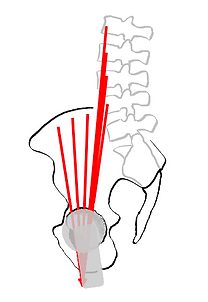
While this illustration is simplified, these muscles can create both a compressive and forward-pulling force on the low back when they become stiff or overactive.
Train Your Core
Your trunk and core muscles help provide stability and control to the spine during movement so the hips and lower extremities can move more efficiently. While current research suggests that core exercises are not necessarily superior to other forms of exercise for low back pain, improving strength, coordination, and movement control can still be helpful — particularly as people return to more demanding or complex movements.
Core training does not need always to be extreme or overly complicated. In most cases, consistency and gradual progression matter far more than advanced exercises or chasing fatigue.
Activate and Strengthen Your Glutes
Weak or poorly coordinated glutes are incredibly common in people who sit most of the day.
When the glutes are not contributing appropriately during movement, the hamstrings and low back muscles often try to compensate. Over time this can increase stress on the lumbar spine.
Helpful Habits Outside the Office
Aside from addressing common biomechanical issues directly, the following a few additional pieces of advice that are also helpful for managing a high-stress job that requires long hours at a desk.

Take Breaks
You are never going to run out of work.
Five to ten minutes of movement every hour is unlikely to hurt your productivity, but it can help tremendously with stiffness and fatigue.
Stand up.
Walk around.
Let your neck move.
Let your hips move.
And if possible, stop staring at your phone during the break too.

Develop an Exercise Routine
One of the most common questions patients ask me is what I personally do to stay healthy.
I still use many of the same mobility, strength, and movement principles I teach patients.
As I get older, my goals have shifted. I care less about pushing maximum performance and more about maintaining a balance between mobility, strength, endurance, and resilience so I can continue running, hiking, working out, and treating patients for years to come.
Your goals may look different than mine, but having some consistent form of exercise is one of the best long-term investments you can make for your body.

Other Things Patients Commonly Find Helpful
Over the years, many patients have also reported benefit from things like:
-
Yoga or stretching routines
-
Meditation
-
Walking regularly
-
Anti-inflammatory nutrition habits
-
Turmeric or curcumin supplementation
-
Heat therapy or baths
-
Topical CBD creams
These are not magic fixes, but they can complement good treatment and movement habits.
Final Thoughts
Treatment, exercise, and better habits all work best when they support each other.
Most people do not need perfect posture or perfect movement. They simply need a body that moves well enough, feels strong enough, and is resilient enough to tolerate the demands of their life.
If you need help getting there, I’m happy to help.
-Dr. Wen
