

MOVEMENT
FUNDAMENTALS
Preparation For What Comes Next in Your Journey
Many patients reach a point where pain is no longer a primary concern and want to begin training again, but are unsure how to start or struggle to progress to higher levels without setbacks.
Movement Fundamentals is a structured, doctor-supervised training program designed by Dr. Wen to bridge the gap between clinical care and higher levels of training.

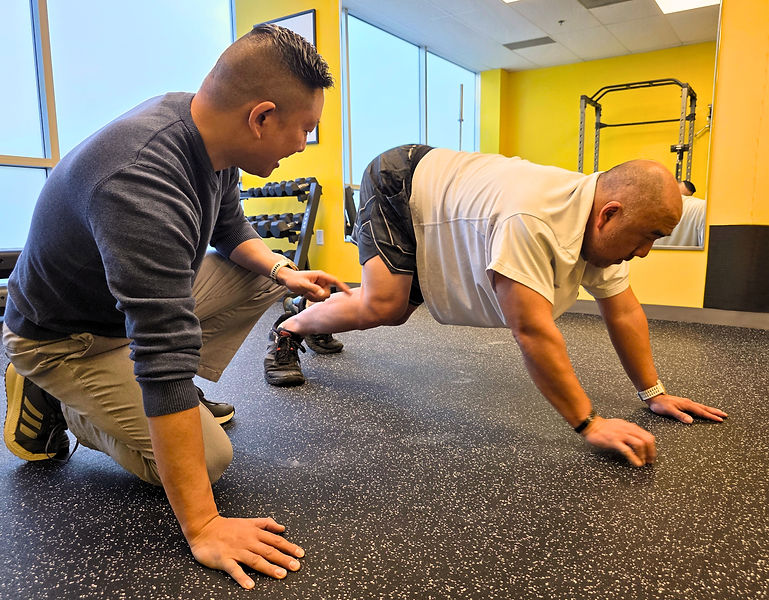
Increase Mobility and Control
This program addresses mobility and motor control through structured exposure. We work to improve mobility where it is limited while building control within that new range. Over time, movements that once felt stiff or unstable begin to feel more natural and dependable.
Built on Respect for Physiology
Muscles and tendons adapt at different rates. Muscle response to training is often understood, but tendon physiology is frequently overlooked. When loading increases too quickly, that imbalance is often where problems develop — especially as the body becomes less forgiving to sudden increases in load over time.
You’ll progress through structured phases that respect how both tissues adapt. Controlled loading gradually builds toward more dynamic work, allowing the body time to respond appropriately rather than react defensively.
Leave Confident for What’s Next
This is not a performance-maximizing program. It is preparation.
By the end, participants should feel comfortable walking into a gym, joining a class, or working with a trainer. Foundational movement patterns become familiar, and the body is prepared to handle increased demands.
Established relationships with respected local trainers allow for referrals when desired, helping to ensure a smooth transition into the next stage.

Meng Y. C.
Movement Fundamentals Participant
A long-distance runner who had been self-coaching for years gained a clearer understanding of how his body responds to training, allowing him to take a more structured and sustainable approach moving forward.
Well Understood. Well Applied.
The concepts behind this program are evidence-based and widely understood. The difference is in how they are applied.
The program follows a structured progression designed to build the body’s tolerance to load while improving mobility, control, and movement complexity over time. Each phase builds on the previous one, allowing adaptation to occur without unnecessary setbacks.
Phase 1 – Isometrics
Initial work focuses on controlled isometric loading to begin developing foundational load tolerance. Early mobility work is more controlled and static in nature, helping to expand usable range while reducing irritation.
Phase 2 – Isometrics + Heavy Slow Resistance
As tolerance improves, heavier loading is introduced alongside isometrics to begin developing strength through controlled movement. Mobility work becomes more dynamic, integrating movement with control.
Phase 3 – Heavy Slow Resistance
Load tolerance is further developed through slower, more demanding movements that allow tissues to adapt under increasing stress. Exercises begin to require and reinforce the mobility developed in earlier phases.
Phase 4 – Dynamic Training
Movement becomes more fluid and representative of real training, preparing the body for higher levels of activity. Mobility work becomes more targeted, supporting individual needs and the demands of specific training.
Mobility, control, and movement quality are developed throughout, with progression tailored to how the body responds at each stage.
Accountability, experience, measured progression, and patience are what consistently lead to meaningful outcomes.
Kathleen K.
Movement Fundamentals Participant
A previously active nurse who had stepped away from regular training due to life circumstances and pain found a structured way to return to exercise after treatment, while continuing to build beyond where she had been before.
How The Process Begins
Movement Fundamentals is offered to current patients once pain has been addressed and the body is ready to transition into more structured training.
The process begins with a complimentary evaluation focused on key movement patterns and areas of the body, guided by clinical experience. This helps determine whether there are any remaining limitations that should be addressed before beginning the program.
If no additional clinical work is needed, a training cadence is established and progression begins through the structured phases over the course of several months.
Designed for busy professionals who need a sustainable way to return to exercise

Shannon M.
Movement Fundamentals Participant
"My career has me sitting at a desk for extended periods of time 6-7 days a week. Unsurprisingly, my stagnant life has only compounded my back problems.
Movement Fundamentals has been a game changer. The customized program has given me the skills to strengthen my body in low impact ways to advance my capability to be more active.
I think this program would be great for anyone who is just fully recovered from surgery or injury and is perfect for anyone who has a desire to get ahead of the pain for once."
Eric R.
Movement Fundamentals Participant
A military veteran that frequently encountered injuries in the past with intense training discovers better body awareness and habits to improve mobility and control.
Who Is This For?
Movement Fundamentals is designed for individuals who are ready to move beyond pain and want a structured, thoughtful approach to training.
This program is a good fit for those who:
-
Have completed treatment but do not feel confident progressing on their own
-
Have struggled to stay consistent with exercise due to setbacks or uncertainty
-
Want a clear, structured path back to training without guesswork
-
Are balancing a busy schedule and need an approach that is realistic and sustainable
-
Are looking to build long-term capacity rather than push through short-term gains